Moldova
Flag of Moldova
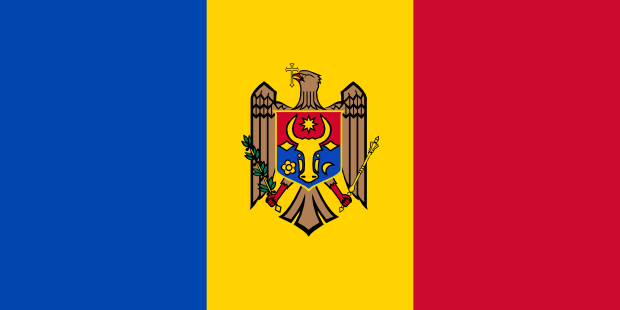
Flag is available in resolutions
| Icon 88x44 |  |
| Icon 32x16 |  |
Moldova
The Republic of Moldova: A Land of Vineyards, History, and Resilience
Moldova, officially the Republic of Moldova, is a landlocked country nestled in Eastern Europe, bordered by Romania to the west and Ukraine to the north, east, and south. Often overlooked in the grand tapestry of European nations, Moldova possesses a rich and complex history, a unique cultural identity shaped by centuries of diverse influences, and a landscape dominated by rolling hills, fertile plains, and the meandering rivers of the Dniester and Prut. Its story is one of resilience, of a people who have navigated periods of foreign rule, economic hardship, and geopolitical shifts, emerging with a distinct character and a deep connection to their land and traditions.
The population of Moldova is approximately 2.6 million people, though this figure fluctuates due to significant emigration, a defining characteristic of the Moldovan experience in recent decades. The majority of the population identifies as Moldovan, with a significant Romanian-speaking minority, reflecting the historical and linguistic ties to neighboring Romania. Other ethnic groups include Ukrainians, Russians, Gagauz – a Turkic-speaking Orthodox Christian minority – and Bulgarians. This mosaic of ethnicities has contributed to Moldovas diverse cultural heritage, evident in its music, dance, cuisine, and festivals. The official language is Moldovan, which is linguistically identical to Romanian, though the use of the Cyrillic alphabet during the Soviet era has left a lingering imprint on some older generations and in certain regions. The predominant religion is Orthodox Christianity, with the Moldovan Orthodox Church playing a significant role in national life.
Moldovas history is a long and often tumultuous chronicle, marked by the ebb and flow of empires. The territory has been inhabited since prehistoric times, with evidence of early human settlements found throughout the country. In antiquity, it was part of Dacia, a kingdom that resisted Roman expansion for a considerable period before eventually being conquered. Following the Roman withdrawal, the region was subjected to waves of migrations and invasions by various peoples, including Goths, Huns, and Slavs. The medieval period saw the rise of the Principality of Moldavia, a powerful entity that stretched from the Carpathian Mountains to the Dniester River. This era was characterized by a struggle for independence against powerful neighbors like the Ottoman Empire and the Kingdom of Poland. The legendary figure of Stephen the Great, a prince who reigned in the 15th century, is revered as a national hero for his valiant defense of Moldavia against Ottoman incursions.
The 18th and 19th centuries brought significant changes, with the eastern part of the principality, Bessarabia, being annexed by the Russian Empire in 1812. This marked the beginning of a long period under Russian and later Soviet rule, which profoundly shaped Moldovas social, political, and economic landscape. Following the collapse of the Russian Empire in 1917, Bessarabia briefly united with Romania in 1918, a period that remains a point of historical debate and national sentiment. However, in 1940, following the Molotov-Ribbentrop Pact, Bessarabia was occupied by the Soviet Union and incorporated into the USSR as the Moldavian Soviet Socialist Republic. This period saw forced collectivization, industrialization, and significant demographic shifts, including the deportation of many ethnic Romanians and the settlement of Russians and Ukrainians. The country regained its independence in 1991 with the dissolution of the Soviet Union, becoming the Republic of Moldova. The post-independence era has been characterized by efforts to establish a stable democracy, rebuild its economy, and navigate the complex geopolitical realities of the region, including the unresolved Transnistria conflict, a breakaway region with a Russian-speaking majority that declared independence from Moldova in 1990.
Geographically, Moldova is characterized by its fertile chernozem soils, making it an agriculturally rich nation. The landscape is predominantly hilly, with elevations rarely exceeding 430 meters. The country is divided by the Dniester River, which flows from north to south, forming a significant portion of its eastern border with Ukraine. The Prut River, a tributary of the Danube, forms the western border with Romania. Moldovas climate is temperate continental, with warm summers and cold, snowy winters. The country is rich in natural resources, with fertile land being its most valuable asset. Forests cover a relatively small percentage of the territory, primarily in the north and central regions. The agricultural sector remains the backbone of the Moldovan economy, with a strong emphasis on viticulture and winemaking, fruit and vegetable cultivation, and grain production.
The economy of Moldova has undergone significant transformations since independence. Historically, it was heavily reliant on agriculture and Soviet-era industrial enterprises. While agriculture remains crucial, the service sector has grown considerably in recent years. Key industries include food processing, particularly wine and spirits production, which is a major export. Moldova is renowned for its high-quality wines, with centuries-old winemaking traditions and extensive vineyards that produce a variety of red, white, and sparkling wines. Other important sectors include textiles, machinery, and light manufacturing. However, Moldova faces economic challenges, including a relatively low GDP per capita, high unemployment rates, and a significant reliance on remittances from Moldovans working abroad. Efforts are underway to attract foreign investment, modernize infrastructure, and diversify the economy.
Moldovas tourism potential, while perhaps not as widely recognized as that of its Western European counterparts, is steadily growing, offering a glimpse into a more authentic and less commercialized European experience. The capital city, Chiinău, is a vibrant urban center with a mix of Soviet-era architecture and modern developments. Its parks, museums, and bustling markets offer a taste of Moldovan life. The National Museum of Ethnography and Natural History provides a deep dive into the countrys rich cultural heritage and natural environment. However, the true charm of Moldova often lies beyond the capital. The Orheiul Vechi (Old Orhei) archaeological complex is a UNESCO World Heritage Tentative List site, featuring a medieval monastic cave complex carved into a limestone cliff overlooking the Răut River. This site offers a captivating glimpse into Moldovas past and breathtaking natural beauty. For wine enthusiasts, Moldova is a paradise. Numerous wineries, from large-scale producers to small family-run establishments, offer tours, tastings, and the opportunity to learn about the intricate process of winemaking. The Cricova winery, one of the largest wine cellars in the world, is a subterranean city of wine tunnels spanning kilometers, a truly unique experience. The Milestii Mici winery holds a Guinness World Record for the largest wine collection. Beyond wine, Moldovas rural landscapes offer opportunities for ecotourism, hiking, and experiencing traditional village life. The Gagauz autonomy, in the south, offers a distinct cultural experience with its own traditions and language.
In conclusion, Moldova is a country of captivating contrasts and enduring spirit. Its history is a testament to the resilience of its people, who have preserved their identity through periods of foreign domination and political upheaval. Its geography, characterized by fertile plains and rolling hills, has shaped its agricultural prowess, particularly in the realm of winemaking. While facing economic and geopolitical challenges, Moldova continues to forge its own path, offering a unique and authentic European experience to those who venture to explore its rich heritage, its warm hospitality, and its burgeoning tourism potential. It is a land where ancient traditions meet modern aspirations, a country quietly carving its place on the European map.
Information about Moldova
The information comes from the publication CIA The World Factbook.
Automated text translation, excuse errors, please!
Country Moldova is situated in a location / continent Europe. Moldova has an area of 33 851 km2 and 3 656 843 residents. The highest point has a height 430 above sea level. and it is called Dealul Balanesti. The lowest point is located at the level of 2 above sea level and it is named Dniester River. System of government is republic and the date of independence 27th August 1991. The capital city is Chisinau (Kishinev). Moldova has the international abbreviation MD.
Moldova - economy
Total gross domestic product (GDP) is 12 150 000 000 $. Total gross domestic product per capita in purchasing power parity is 3 400 $. GDP grows by 6.40 % a year. Inflation (consumer price index) is equal to 7.60 % a year. Moldova have 1 270 000 working-age population (from a total population 3 656 843 people). Unemployment is at 6.70 %. Moldova issued 11.90 % GDP to healt care and 0,40 % GDP to army. The public debt of the country is 29.30 % GDP. The total amount of foreign debt is 5 200 000 000 USD.
Moldova - demography
As suggested above, Moldova has 3 656 843 people. Population growth is in the amount -1.01 % per year. Number of children born per 1000 population per year is 12.50.Every mother has average 1.55 children. The infant mortality rate is 13.65 and maternal mortality 41.00 deaths per 100,000 births. Average estimated life expectancy makes 69.51 years. Mortality is 12.62 people per 1000 population per year.
Moldova - transport and telecommunications
Moldova has 9 343 km of roads, 1 190 km of railway lines and 10 airports. The total length of waterways (navigable rivers, canals, etc.) is 558 km. There is registered 121 ships.
Number of active mobile phones (sim card) in the country Moldova is 3 715 000. Number of active fixed telephone lines is 1 180 000. Moldova has 1 333 000 internet users, who have the available 696 685 Internet connections. Moldova has been assigned a domain first Choose range .md.
Moldova - energetics
Moldova consumes a year 3 416 000 000 kWh of electricity. Annual electricity production is 3 386 000 000 kWh in power plants with a total installed electrical capacity 551 000 kW. Moldova exports 0 kWh and imports 1 464 000 000 kWh of electricity per year Energy mix of power generation is as follows: fossil fuels: 88.4 %, nuclear energy: 0 %, renewable: 0.0 %, hydropower: 11.6 %.
Keywords: Moldova, list of flags, information, energetics, Flags of countries, all flags, flag, flags of countries in the world, transport, Flag of Moldova, economy, telecommunications, national flags, world countries, list of countries, demography, flag states, politic.