San Marino
Flag of San Marino
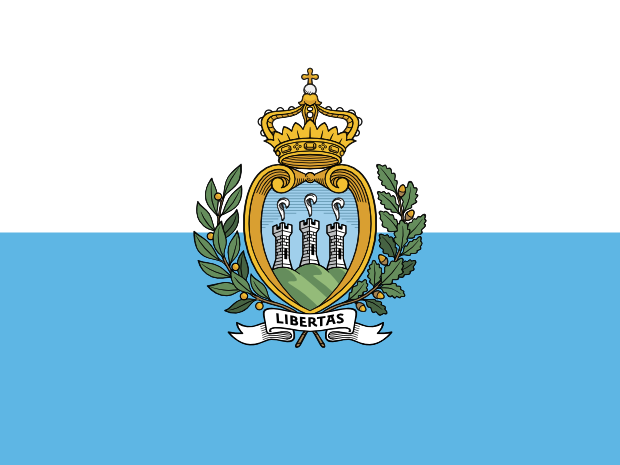
Flag is available in resolutions
| Icon 88x66 |  |
| Icon 32x24 |  |
San Marino
San Marino: A Microcosm of History, Independence, and Alpine Charm
Nestled high in the Apennine Mountains, overlooking the Adriatic coast of Italy, lies the Republic of San Marino, a tiny sovereign state that defies its diminutive size with a colossal history and an enduring spirit of independence. Often overshadowed by its larger Italian neighbors, San Marino is a fascinating land of ancient fortresses, breathtaking vistas, and a unique cultural identity forged over seventeen centuries. It is the worlds oldest republic and one of its smallest countries by both area and population, yet it punches well above its weight in terms of historical significance and tourist appeal. The very notion of a republic existing for so long, unbroken, is remarkable, a testament to its strategic location and the resilience of its people. Its rich tapestry of history is woven with threads of monasticism, medieval warfare, and a persistent commitment to self-governance, making it a compelling subject for exploration.
The story of San Marino begins in the year 301 AD, when a Christian stonemason named Saint Marinus, fleeing persecution in Roman Dalmatia, sought refuge on the rugged slopes of Mount Titano. He was accompanied by a small group of followers, and together they established a monastic community. Marinus, who would later be canonized, is revered as the founder of the republic, and his legacy of humility and devotion is deeply ingrained in the nations identity. Over the ensuing centuries, the community grew, and its inhabitants, known as Sammarinesi, gradually consolidated their independence. They successfully resisted numerous attempts by feudal lords and neighboring states to absorb them, often through shrewd diplomacy and their formidable natural defenses. The republics early charters and statutes, some dating back to the 13th century, laid the groundwork for its unique political system, which has remarkably retained many of its ancient democratic principles. The legend of Saint Marinus is central to the Sammarinese narrative, providing a foundational myth that underscores their long-held desire for freedom and self-determination. The republics ability to maintain its sovereignty for so long is often attributed to its strategic isolation and the respect it commanded from larger powers, who often found it more advantageous to recognize its independence than to attempt conquest.
Geographically, San Marino is a jewel box of dramatic landscapes. It is entirely surrounded by Italy, a fact that has shaped its history and its economy. The dominant feature is Mount Titano, a towering peak that rises to 749 meters (2,457 feet) above sea level. The republics territory is concentrated on the slopes and summit of this mountain, creating a breathtaking and picturesque environment. The three iconic towers – Guaita, Cesta, and Montale – perched atop the ridges of Mount Titano, are not merely historical monuments but also symbols of San Marinos enduring strength and vigilance. From these vantage points, panoramic views stretch across the rolling hills of the Emilia-Romagna and Marche regions of Italy, all the way to the shimmering Adriatic Sea. The climate is Mediterranean, with hot, dry summers and mild, wet winters, though the mountain elevation can lead to cooler temperatures and occasional snow. The small size of the country means that distinct geographical regions are not a significant feature, but rather the entire nation is characterized by its mountainous terrain and its proximity to the Italian plains. The natural beauty of San Marino is a significant draw for tourists, offering a rugged and unspoiled landscape that contrasts with the more developed coastal areas of Italy.
The population of San Marino is small, numbering just over 33,000 people. The vast majority are Sammarinesi, with a significant minority of Italian residents. The official language is Italian, though a distinct local dialect, Sammarinese, is also spoken, particularly by older generations. The culture is deeply influenced by its Italian neighbors, yet it possesses its own unique traditions, festivals, and a strong sense of national pride. The Sammarinese are known for their hospitality and their commitment to preserving their heritage. The strong sense of community is palpable, fostered by the shared history and the close-knit nature of a small population. Family ties are important, and traditions are passed down through generations, contributing to the republics unique cultural fabric. Despite its small size, San Marino has a well-developed social welfare system and a high standard of living, reflecting its economic stability and its commitment to the well-being of its citizens.
Economically, San Marino has undergone a significant transformation over the centuries. Historically, its economy was largely agrarian, with a reliance on agriculture and animal husbandry. However, in more recent times, it has diversified considerably, with a strong emphasis on tourism, financial services, and light manufacturing. The striking scenery and historical sites attract hundreds of thousands of tourists annually, making tourism a vital source of revenue. The republic also benefits from its status as a tax haven, attracting foreign investment and businesses. The sale of postage stamps and commemorative coins is another significant income generator, appealing to collectors worldwide. The manufacturing sector produces a range of goods, including ceramics, furniture, and clothing. While not a member of the European Union, San Marino has a customs union with the EU and uses the Euro as its currency, facilitating trade and economic integration. The countrys economic model has proven remarkably resilient, adapting to changing global economic landscapes while maintaining its independent status. The financial sector, in particular, plays a crucial role, though it has also faced scrutiny and reform in recent years.
San Marinos tourist attractions are primarily centered around its historical core and the stunning natural beauty of Mount Titano. The Three Towers – Guaita, Cesta, and Montale – are the undisputed highlights. Guaita, the oldest, dates back to the 11th century and offers commanding views. Cesta, built in the 13th century, houses a museum of ancient weapons. Montale, the smallest and most remote, was completed in the 15th century. These fortresses are not just relics of the past but are living symbols of San Marinos enduring defense and sovereignty. The historic center of San Marino, a UNESCO World Heritage site, is a charming labyrinth of cobblestone streets, medieval architecture, and picturesque squares. The Basilica di San Marino, a neoclassical church dedicated to the founder, is an important religious site. The Palazzo Pubblico, the seat of government, is a striking building that showcases the republics administrative heart. Beyond the capital, the countryside offers opportunities for hiking and exploring, with well-marked trails leading through forests and offering spectacular viewpoints. The annual Medieval Days festival, a reenactment of historical events, draws large crowds and offers a glimpse into the republics past. The unique appeal of San Marino lies in its ability to transport visitors back in time, offering an authentic and immersive historical experience. The compact nature of the country also means that most major attractions are within easy walking distance, making exploration a pleasure.
San Marinos political system is a unique blend of ancient traditions and modern democracy. It is a parliamentary republic with a bicameral legislature, the Grand and General Council, composed of 60 members elected every five years. The Captains Regent, two heads of state, are elected from among the council members for a six-month term, a tradition that dates back to the 13th century. This dual leadership system, with its rotating terms, was designed to prevent any single individual from accumulating too much power, a reflection of the republics deep-seated commitment to checks and balances. The judiciary is independent, and the legal system is based on Roman law. The republic has a long tradition of neutrality and has managed to avoid entanglement in major conflicts throughout its history. Its diplomatic relations are cordial, and it is a member of various international organizations. The strength of San Marinos political system lies in its stability and its ability to adapt to changing times while preserving its fundamental democratic principles. The adherence to ancient traditions, such as the Captains Regent, provides a tangible link to its past and reinforces its unique identity.
In conclusion, San Marino is far more than just a geographical curiosity; it is a living testament to the enduring power of independence, history, and self-determination. From its monastic origins on Mount Titano to its modern-day status as a thriving microstate, it has consistently charted its own course, preserving its unique identity against the tides of history. Its stunning natural beauty, its well-preserved historical sites, and its proud cultural heritage make it a captivating destination. For those seeking a journey into the past, a glimpse of breathtaking landscapes, and an appreciation for a truly unique nation, San Marino offers an unforgettable experience, a small republic with a giant spirit that continues to inspire. The resilience of its institutions and the pride of its people are palpable, creating an atmosphere that is both historically significant and remarkably inviting. It is a place where history is not just remembered but lived, a truly remarkable corner of the world.
Information about San Marino
The information comes from the publication CIA The World Factbook.
Automated text translation, excuse errors, please!
Country San Marino is situated in a location / continent Europe. San Marino has an area of 61 km2 and 32 140 residents. The highest point has a height 755 above sea level. and it is called Monte Titano. The lowest point is located at the level of 55 above sea level and it is named Torrente Ausa. System of government is republic and the date of independence Third September 301. The capital city is San Marino. San Marino has the international abbreviation SM.
San Marino - economy
Total gross domestic product (GDP) is 1 136 000 000 $. Total gross domestic product per capita in purchasing power parity is 36 200 $. GDP grows by 0.80 % a year. Inflation (consumer price index) is equal to 3.10 % a year. San Marino have 22 050 working-age population (from a total population 32 140 people). Unemployment is at 5.50 %. San Marino issued 7.10 % GDP to healt care .
San Marino - demography
As suggested above, San Marino has 32 140 people. Population growth is in the amount 0.98 % per year. Number of children born per 1000 population per year is 8.90.Every mother has average 1.48 children. The infant mortality rate is 4.65 .Average estimated life expectancy makes 83.07 years. Mortality is 8.06 people per 1000 population per year.
San Marino - transport and telecommunications
San Marino has 292 km of roads.
Number of active mobile phones (sim card) in the country San Marino is 35 500. Number of active fixed telephone lines is 18 700. San Marino has 17 000 internet users, who have the available 11 097 Internet connections. San Marino has been assigned a domain first Choose range .sm.
San Marino - energetics
.
Keywords: information, list of countries, list of flags, flag, San Marino, energetics, telecommunications, flags of countries in the world, world countries, transport, economy, demography, national flags, flag states, Flag of San Marino, all flags, Flags of countries, politic.