Andorra
Flag of Andorra
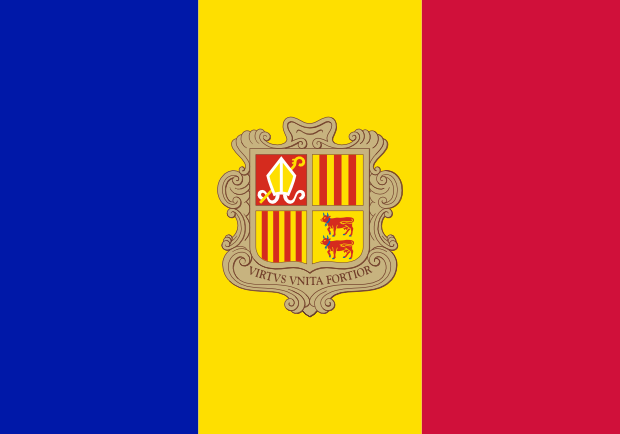
Flag is available in resolutions
| Icon 88x62 |  |
| Icon 32x22 |  |
Andorra
Andorra: A Pyrenean Gem of Sovereignty and Scenery
Nestled high in the eastern Pyrenees, between the towering peaks of Spain and France, lies the diminutive principality of Andorra. This landlocked nation, often overlooked in broader geopolitical discussions, possesses a unique and captivating character, shaped by its dramatic geography, rich history, and distinct political structure. With an area of just 468 square kilometers, Andorra is Europe’s sixth-smallest country, yet its allure far exceeds its physical dimensions. Its breathtaking mountainous landscapes, coupled with a thriving economy and a deeply rooted cultural heritage, make it a compelling destination for both intrepid adventurers and those seeking a tranquil escape. The very essence of Andorra is intertwined with its formidable mountain setting, a natural fortress that has historically played a crucial role in safeguarding its independence and fostering its unique identity. The soaring peaks, verdant valleys, and crystal-clear rivers are not merely backdrops but active participants in the narrative of this resilient principality.
The population of Andorra, though small, is remarkably diverse. As of recent estimates, the principality is home to approximately 80,000 inhabitants. What is particularly striking about Andorra is the demographic composition: Andorrans themselves constitute a minority within their own country, making up around 35-40% of the population. The majority are immigrants, drawn by the principality’s economic opportunities and high quality of life. Spaniards form the largest expatriate group, followed by French nationals, Portuguese, and other Europeans. This multicultural tapestry has enriched Andorra’s society, contributing to a vibrant and cosmopolitan atmosphere, particularly in its urban centers. Despite the diverse origins of its residents, a strong sense of national identity prevails, nurtured by shared traditions, the Catalan language, and a collective pride in their country’s unique sovereignty. The official language is Catalan, a Romance language spoken in Catalonia, the Balearic Islands, and parts of Aragon and Valencia in Spain, as well as in the French department of Pyrénées-Orientales. Spanish and French are also widely spoken and understood, reflecting the country’s close ties with its neighbors. The Andorran people are known for their warmth and hospitality, a trait often attributed to their close-knit communities and the shared experience of living in such a secluded yet welcoming environment.
The history of Andorra is a fascinating saga of resilience and self-determination, stretching back over a millennium. Its origins are shrouded in legend, but the most widely accepted account points to the establishment of the Co-Princeship in the 13th century. This unique arrangement, still in place today, designates the Bishop of Urgell in Spain and the President of France as Andorra’s co-princes and heads of state. This dual sovereignty, born out of complex feudal arrangements and disputes, has been instrumental in preserving Andorra’s independence from its more powerful neighbors. For centuries, Andorra remained largely isolated, its mountainous terrain acting as a natural defense. This isolation allowed it to develop its own distinct legal system, governance, and cultural practices. During the Spanish Civil War and World War II, Andorra maintained a precarious neutrality, further solidifying its reputation as a peaceful haven. In the latter half of the 20th century, Andorra began to open up to the outside world, transforming from a relatively isolated agricultural society into a modern European nation. The development of tourism and its status as a tax haven were key drivers of this economic and social evolution. The country’s long history of independence, negotiated and maintained through diplomacy and its unique political structure, is a source of immense national pride and a testament to its enduring spirit.
Geographically, Andorra is a masterpiece of alpine beauty. The principality is entirely mountainous, dominated by the Pyrenean range. The highest peak, Coma Pedrosa, reaches an impressive 2,942 meters. The landscape is characterized by steep valleys, dramatic cliffs, and numerous glacial lakes, often referred to as “estanys” in Catalan. The Valira River, the country’s main watercourse, flows through the heart of Andorra, carving out the principal valleys where most of the population and economic activity are concentrated. The capital city, Andorra la Vella, is one of the highest capital cities in Europe, situated at an altitude of 1,023 meters. The climate is typical of a high mountain region, with cold, snowy winters and mild, pleasant summers. The annual rainfall is moderate, and the country experiences significant sunshine, especially during the summer months. This stunning natural environment not only provides a breathtaking setting for life in Andorra but also forms the bedrock of its most significant industry: tourism. The dramatic peaks and pristine valleys offer unparalleled opportunities for outdoor recreation, drawing visitors from across the globe to experience the raw beauty of the Pyrenees.
The Andorran economy has undergone a remarkable transformation, evolving from its agrarian roots to become a prosperous service-based economy. For many years, Andorra’s primary economic drivers were agriculture and trade, with its strategic location facilitating cross-border commerce. However, the modern Andorran economy is overwhelmingly dominated by tourism and its status as a low-tax jurisdiction. The principality is renowned for its duty-free shopping, attracting vast numbers of visitors seeking high-quality goods at competitive prices, particularly in fashion, electronics, and luxury items. Beyond shopping, Andorra boasts an exceptional ski infrastructure, with world-class resorts like Grandvalira and Vallnord attracting skiers and snowboarders from November to April. Summer tourism is equally popular, with visitors drawn to hiking, mountain biking, and the stunning natural scenery. The financial services sector also plays a significant role, with Andorra’s banking system historically benefiting from its discreet financial environment. While some aspects of its tax policies have been subject to international scrutiny and reform in recent years, the country continues to attract investment and businesses. The government actively invests in infrastructure and the promotion of its tourism sector, recognizing it as the lifeblood of the nation’s prosperity. The resilience of its economy, despite its small size and unique geopolitical position, is a testament to its adaptability and strategic vision.
Andorra’s tourist attractions are as diverse as its landscape, catering to a wide range of interests. The undisputed stars are its world-class ski resorts. Grandvalira, the largest ski area in the Pyrenees, offers over 200 kilometers of slopes, catering to all levels of skiers and snowboarders, with state-of-the-art facilities and breathtaking panoramic views. Vallnord, another major resort, provides a slightly more intimate experience, particularly popular with families and freeride enthusiasts. Beyond skiing, the summer months transform Andorra into an outdoor playground. Hiking trails crisscross the mountains, offering routes for all abilities, from gentle strolls through picturesque valleys to challenging ascents of the highest peaks. Mountain biking is also a burgeoning activity, with dedicated trails and bike parks. For those seeking cultural immersion, Andorra la Vella offers a charming old town with Romanesque churches, like the Church of Sant Joan de Caselles, and traditional stone houses. The Casa de la Vall, a historic building that once served as Andorra’s parliament, is a must-visit for history enthusiasts. The thermal spa resort of Caldea, with its futuristic architecture and vast array of wellness facilities, provides a luxurious and relaxing experience. Nature lovers will be captivated by the Madriu-Perafita-Claror Valley, a UNESCO World Heritage site, which showcases Andorra’s pristine natural beauty and traditional rural life. The principality’s commitment to preserving its natural heritage, coupled with its diverse recreational offerings, ensures that Andorra remains an attractive destination year-round, offering a unique blend of adventure, relaxation, and cultural discovery.
Information about Andorra
The information comes from the publication CIA The World Factbook.
Automated text translation, excuse errors, please!
Country Andorra is situated in a location / continent Europe. Andorra has an area of 468 km2 and 85 082 residents. The highest point has a height 2 946 above sea level. and it is called Coma Pedrosa. The lowest point is located at the level of 840 above sea level and it is named Rio Runer. System of government is republic.The capital city is Andorra la Vella. Andorra has the international abbreviation AN.
Andorra - economy
Total gross domestic product (GDP) is 3 169 000 000 $. Total gross domestic product per capita in purchasing power parity is 37 200 $. GDP grows by -1.80 % a year. Inflation (consumer price index) is equal to 1.60 % a year. Andorra have 38 220 working-age population (from a total population 85 082 people). Unemployment is at 2.90 %. Andorra issued 7.70 % GDP to healt care .
Andorra - demography
As suggested above, Andorra has 85 082 people. Population growth is in the amount 0.27 % per year. Number of children born per 1000 population per year is 9.26.Every mother has average 1.36 children. The infant mortality rate is 3.76 .Average estimated life expectancy makes 82.50 years. Mortality is 6.52 people per 1000 population per year.
Andorra - transport and telecommunications
Andorra has 320 km of roads.
Number of active mobile phones (sim card) in the country Andorra is 65 000. Number of active fixed telephone lines is 38 400. Andorra has 67 100 internet users, who have the available 28 131 Internet connections. Andorra has been assigned a domain first Choose range .ad.
Andorra - energetics
Andorra consumes a year 598 700 000 kWh of electricity. Annual electricity production is 101 000 000 kWh .Andorra exports 9 000 000 kWh and imports 497 700 000 kWh of electricity per year.
Keywords: list of countries, flag states, information, flag, list of flags, Flag of Andorra, Flags of countries, all flags, economy, telecommunications, national flags, flags of countries in the world, transport, Andorra, demography, energetics, world countries, politic.