Croatia
Flag of Croatia
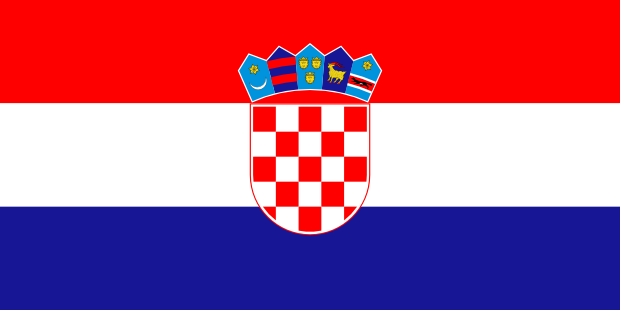
Flag is available in resolutions
| Icon 88x44 |  |
| Icon 32x16 |  |
Croatia
Croatia: A Jewel of the Adriatic
Croatia, officially the Republic of Croatia, is a captivating country situated at the crossroads of Central and Southeastern Europe. Bordered by Slovenia to the northwest, Hungary to the north, Serbia to the east, Bosnia and Herzegovina to the southeast, and the Adriatic Sea to the southwest, its strategic location has profoundly shaped its rich and complex history. With a population of approximately 3.88 million people, Croatians are known for their warmth and hospitality, a testament to their deep-rooted cultural heritage. The country’s identity is a vibrant tapestry woven from centuries of influence by various empires, from the Romans and Byzantines to the Venetians, Ottomans, and Austro-Hungarians, all leaving their indelible mark on its architecture, cuisine, and traditions. The official language is Croatian, a South Slavic tongue, and the predominant religion is Roman Catholicism, underscoring the strong historical ties to Western European culture. The capital city, Zagreb, located in the continental north, is a bustling metropolis that offers a stark contrast to the sun-drenched coastal regions, showcasing a blend of Austro-Hungarian grandeur and modern dynamism.
The geography of Croatia is remarkably diverse, offering a stunning array of landscapes that contribute significantly to its appeal as a tourist destination. The country can broadly be divided into three main geographical regions: the Pannonian Basin in the north, the Dinaric Alps forming a mountainous spine, and the extensive Adriatic coastline. The Pannonian Basin, characterized by fertile plains and rolling hills, is the agricultural heartland of Croatia, where vast fields of grain and vineyards flourish. Rivers like the Sava and Drava traverse this region, supporting a rich ecosystem and providing vital waterways. Moving southwards, the Dinaric Alps present a dramatic and rugged terrain, with towering peaks, deep valleys, and numerous karst formations, including extensive cave systems. This mountainous region is a haven for hikers, climbers, and nature enthusiasts, offering breathtaking vistas and a sense of untamed wilderness. However, it is the Adriatic coastline that truly defines Croatia’s global image. Stretching over 1,777 kilometers, it is dotted with over a thousand islands, islets, and reefs, creating a mesmerizing archipelago. The crystal-clear waters of the Adriatic Sea are an inviting turquoise, perfect for swimming, sailing, and diving. The coastline is characterized by picturesque coves, secluded beaches, and charming medieval towns that cling to the hillsides, their terracotta roofs a striking contrast against the azure sea. Notable natural wonders include the Plitvice Lakes National Park, a UNESCO World Heritage site renowned for its cascading waterfalls and emerald-green lakes, and the Krka National Park, another stunning natural reserve with impressive waterfalls. The climate varies across these regions, with a continental climate prevalent in the interior, featuring hot summers and cold winters, while the coastal areas enjoy a Mediterranean climate, boasting mild, wet winters and hot, dry summers.
Croatia’s history is a long and often turbulent narrative, shaped by its position as a frontier between major powers. Early inhabitants included Illyrian tribes, followed by Roman colonization which left behind impressive architectural legacies, most notably Diocletian’s Palace in Split. Following the fall of the Roman Empire, the region was settled by Slavic peoples, including the Croats, who established their own principalities. In the 10th century, Croatia became a kingdom, often in union with Hungary, a relationship that lasted for centuries. The Ottoman expansion in the 15th and 16th centuries brought significant conflict and shaped the country’s eastern borders. Much of Croatia, particularly the northern and western parts, fell under Habsburg rule within the Austro-Hungarian Empire for several centuries, leading to the development of its administrative and cultural institutions. The 20th century brought further upheaval. After World War I, Croatia became part of the Kingdom of Yugoslavia. During World War II, it was occupied by Axis powers and became the site of a brutal resistance movement. Following the war, Croatia was a constituent republic within the Socialist Federal Republic of Yugoslavia under Tito’s communist regime. The dream of independence was realized in 1991, leading to the Croatian War of Independence, a painful conflict that lasted until 1995. Since gaining independence, Croatia has focused on rebuilding and integrating into European structures, joining NATO in 2009 and the European Union in 2013. This rich historical tapestry is evident in the numerous archaeological sites, medieval fortresses, and charming old towns that dot the landscape, each telling a story of past glories and struggles.
The Croatian economy has undergone a significant transformation since independence, moving from a centrally planned system to a market-oriented one. While agriculture remains important, particularly in the continental regions, the service sector, driven by tourism, has become the dominant force. Croatias stunning coastline, historic cities, and natural beauty attract millions of visitors annually, making tourism a vital contributor to the GDP and employment. The hospitality industry is well-developed, with a wide range of accommodation options, from luxury hotels to charming guesthouses and campsites. The country also boasts a significant shipbuilding industry, though it has faced challenges in recent years. Other important sectors include food processing, chemicals, pharmaceuticals, and information technology. The EU membership has provided access to a larger market and significant investment funds, aiding in the modernization of infrastructure and various industries. However, challenges remain, including a need for further structural reforms, addressing unemployment, and combating corruption. The country is actively working to diversify its economy and attract foreign investment in areas beyond tourism. Renewable energy sources are also gaining traction, with a growing focus on solar and wind power.
Croatia’s tourist attractions are as diverse as its landscape, offering something for every type of traveler. The Dalmatian coast is undoubtedly the star attraction, with its ancient cities and idyllic islands. Dubrovnik, the “Pearl of the Adriatic,” is a UNESCO World Heritage site famed for its remarkably preserved medieval city walls, offering panoramic views of the shimmering sea. Walking along these walls is an unforgettable experience, transporting visitors back in time. Split, another UNESCO treasure, is built around the magnificent Diocletian’s Palace, a Roman emperor’s retirement home that has evolved into a vibrant city center. The islands, such as Hvar, known for its glamorous nightlife and lavender fields, Brač, home to the iconic Zlatni Rat beach, and Korčula, believed to be the birthplace of Marco Polo, each possess their own unique charm and allure. Inland, the Plitvice Lakes National Park is a natural masterpiece, a wonderland of sixteen interconnected lakes, linked by a series of waterfalls and cascades, set amidst dense forest. The Krka National Park offers similar breathtaking scenery, with the Skradinski Buk waterfall being a particularly popular spot. Zagreb, the capital, provides a different, yet equally engaging, experience. Its Upper Town, with its charming cobblestone streets and historic buildings, contrasts with the more modern Lower Town, boasting grand squares and vibrant cultural institutions, including numerous museums and galleries. The Istrian peninsula, in the northwest, offers a taste of Italian influence, with its rolling vineyards, olive groves, and picturesque coastal towns like Rovinj and Poreč, which feature well-preserved Roman mosaics. For adventure seekers, Croatia offers opportunities for sailing, kayaking, rafting on its rivers, hiking in its national parks, and exploring its numerous caves. The rich culinary scene, influenced by Mediterranean, Italian, and Austro-Hungarian traditions, further enhances the travel experience, with fresh seafood, local wines, and hearty continental dishes being highlights.
In conclusion, Croatia is a country that captivates with its stunning natural beauty, rich history, and vibrant culture. From the ancient Roman ruins and medieval fortresses to the pristine beaches and emerald lakes, it offers a journey through time and a feast for the senses. Its strategic location has imbued it with a unique blend of influences, creating a distinct national identity. As it continues to develop and integrate into the European landscape, Croatia remains a truly remarkable destination, a jewel on the Adriatic waiting to be discovered.
Information about Croatia
The information comes from the publication CIA The World Factbook.
Automated text translation, excuse errors, please!
Country Croatia is situated in a location / continent Europe. Croatia has an area of 56 594 km2 and 4 480 043 residents. The highest point has a height 1 830 above sea level. and it is called Dinara. The lowest point is located at the level of 0 above sea level and it is named Adriatic Sea. System of government is republic and the date of independence 25th June 1991. The capital city is Zagreb. Croatia has the international abbreviation IV.
Croatia - economy
Total gross domestic product (GDP) is 81 360 000 000 $. Total gross domestic product per capita in purchasing power parity is 18 400 $. GDP grows by 0.00 % a year. Inflation (consumer price index) is equal to 2.30 % a year. Croatia have 1 717 000 working-age population (from a total population 4 480 043 people). Unemployment is at 17.70 %. Croatia issued 7.80 % GDP to healt care and 2,39 % GDP to army. The public debt of the country is 43.90 % GDP. The total amount of foreign debt is 66 300 000 000 USD.
Croatia - demography
As suggested above, Croatia has 4 480 043 people. Population growth is in the amount -0.09 % per year. Number of children born per 1000 population per year is 9.57.Every mother has average 1.44 children. The infant mortality rate is 6.06 and maternal mortality 17.00 deaths per 100,000 births. Average estimated life expectancy makes 75.99 years. Mortality is 11.99 people per 1000 population per year.
Croatia - transport and telecommunications
Croatia has 29 343 km of roads, 2 722 km of railway lines and 69 airports. The total length of waterways (navigable rivers, canals, etc.) is 785 km. There is registered 77 ships.
Number of active mobile phones (sim card) in the country Croatia is 5 115 000. Number of active fixed telephone lines is 1 761 000. Croatia has 2 234 000 internet users, who have the available 725 521 Internet connections. Croatia has been assigned a domain first Choose range .hr.
Croatia - energetics
Croatia consumes a year 18 870 000 000 kWh of electricity. Annual electricity production is 14 670 000 000 kWh in power plants with a total installed electrical capacity 4 021 000 kW. Croatia exports 1 916 000 000 kWh and imports 6 600 000 000 kWh of electricity per year Energy mix of power generation is as follows: fossil fuels: 47.2 %, nuclear energy: 0 %, renewable: 0.8 %, hydropower: 44.7 %. The country Croatia is harvested annually 17 650 barrels of oil.
Keywords: world countries, flags of countries in the world, economy, flag states, energetics, Flag of Croatia, information, telecommunications, Croatia, list of flags, national flags, transport, flag, all flags, Flags of countries, demography, list of countries, politic.